Category: Urban Planning

The 3-way street

Update June 12, 2011: Added a link to and excerpt from commentary by David Hembrow, a British blogger in the Netherlands.

How does a 3-way street work? Easy, just watch the video.

I like the term “aggressive yield” to describe the situation when a motorist does yield to pedestrians crossing the street, but in a way where they inch forward continually, slowly pushing, with a buffer or air, the people out of the way.

I really like the comment from Tuesday by Anthony Ball:

those red markers are just showing the limits of tolerable risk as established by years of system development. If the collision speeds were higher, those red circles would be far few – it’s simply a system finding its own point of stability.

If you really want to wreak havoc – try to control that system without corrective feedback (eg more rules, lights, controls, etc) and you’ll see the system kill people while it tries to find new stable relationships.

don’t forget that rules, signs, lights, etc have no direct impact on the system – they only work through the interpretation of the users.

What did David Hembrow have to say? David lives in the Netherlands and disagrees with the common sentiment that these conflicts are caused by selfish users.

I don’t see the behaviour at this junction as being about “bad habits”. What I see is simply a very badly designed junction which almost invites people to behave in the way that they do.

Dutch road junctions don’t look like and work like this – they are different for a reason: it removes the conflicts and improves safety. A long-standing theme of Dutch road design is the concept of Sustainable Safety. The concept is to remove conflict so that collisions are rare and the consequences of those which remain are relatively small. Roads are made self-explanatory so that bad behaviour is reduced and the way people behave is changed.

Reading this reminds me of the work of the students in George Aye’s class at SAIC, “Living in a Smart City.” The students attempted, through an intersection redesign, to reduce the stresses that lead to crashes.

Where are the 3-way streets in your city? Grand/Halsted/Milwaukee in Chicago comes to my mind easily. Also a lot of streets in the Loop. Oh yeah, and The Crotch, at Milwaukee/North/Damen.
Chicago catches up to NYC in one 3-day project

What were Mayor Daley and the previous Transportation commissioners waiting for when it came installing modern and then-innovative bikeway facilities?

Why have Rahm Emanuel, Gabe Klein, and the Chicago Bicycle Program installed every modern and previously-innovative bikeway treatment under the sun in just three days? The project’s not over, but a lot has happened since Monday.

On Day 3 of construction of the Kinzie Street protected bike lane, CDOT builds (photos from the Bicycle Program’s Flickr photostream):

Bike-only left turn on southbound Milwaukee to Kinzie (perfect)

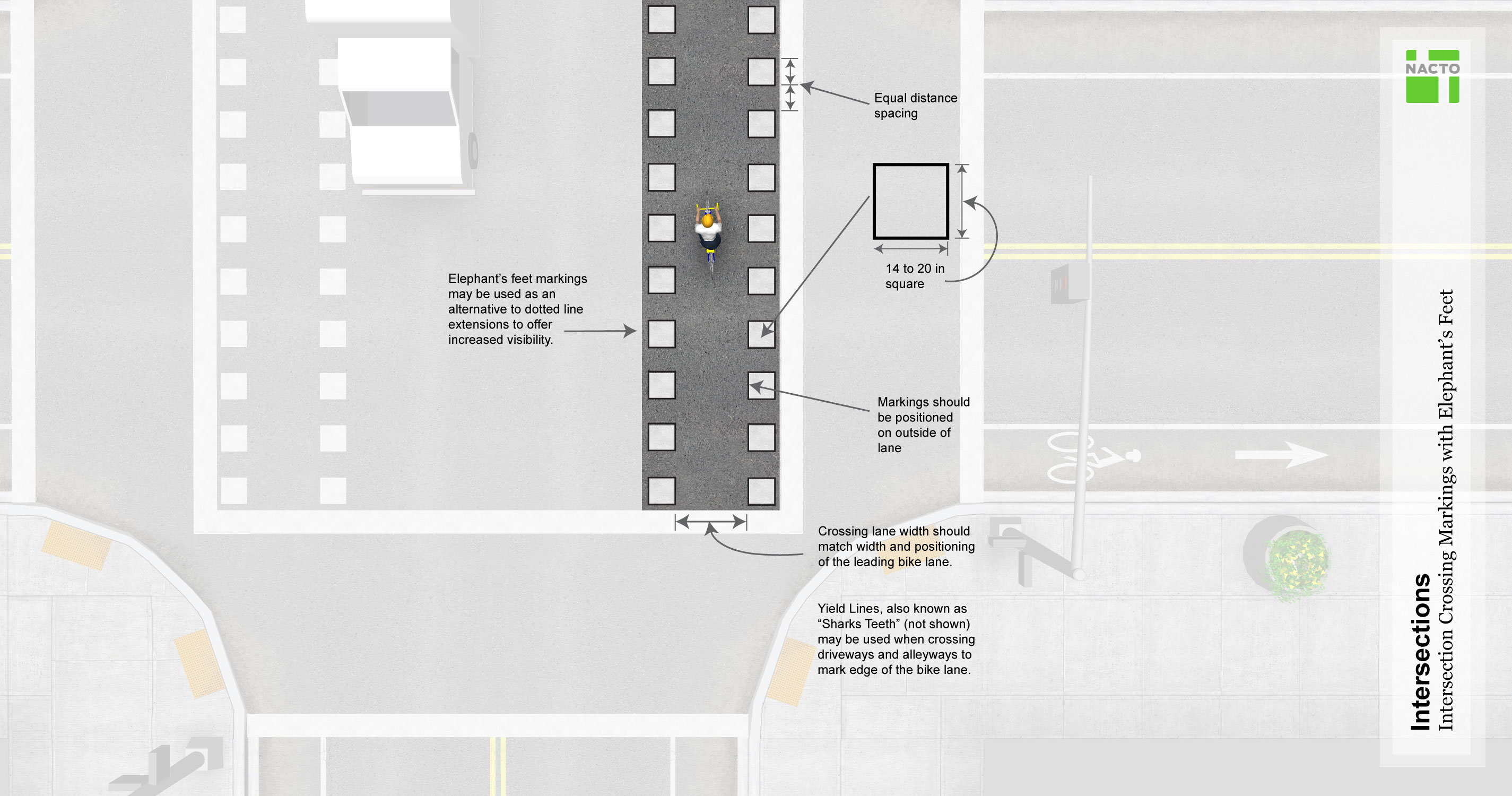
Through-intersection bike lane using European-style “yield squares” (okay, they’re actually called elephant’s feet)*

Same yield squares (elephant’s feet) at driveways.

Very wide!

New signage telling turning drivers to stop for people walking across the street and riding their bikes.

*I always forget that Chicago created its first through-intersection bike lane at Sheridan and Ardmore, at the north terminus of the Lakefront Trail, to get bicyclists onto the on-street bike lane network.

Bike box, another first on Kinzie Street

Update June 7, 2011: CDOT and Mayor Emanuel acknowledge the project with a Tuesday morning press conference. Here’s the press release (that doesn’t reveal anything we don’t already know) and photos from the event. NBC Chicago has video from the press conference (2:27).

A bike box is a well-marked area where bicyclists can queue at signalized intersections ahead of cars, a way to get ahead and make bicyclists more visible to drivers. The Chicago Department of Transportation (CDOT) installed one Tuesday morning, on Day 2 of the Kinzie Street protected bike lane project (read about Day 1). I asked a CDOT worker if it will be painted green or another color and they replied it would probably would. It appears that the design for the project is still being done while construction proceeds. I expect a section of the next block will be worked on tomorrow.

See a bike box in Portland.

More new information about this project

CDOT was also grinding out pavement markings on Kinzie Street in front of Jewel-Osco, where the CDOT worker explained a left-turn lane would be created for westbound travelers (matching the left-turn lane in the eastbound direction next to the bike box).

The uphill bike lane will not be protected. Chicagoist commenter BlueFairline pointed out a conflict with trucks delivering goods via hose to the Blommer chocolate factory. The truck needs to be curbside. Today confirmed how this would work out.

Lastly, the CDOT worker could not confirm if there will be a bike-only left-turn lane on southbound Milwaukee at Kinzie Street, as I suggested earlier.

First photos of protected bike lane on Kinzie Street

As I suspected, construction began today, Monday, June 6, 2011, on Chicago’s first 0.5 miles of protected bike lanes at Kinzie and Desplaines.

Chicago Department of Transportation employees were out on the street this morning striping the bike lane and bike lane buffer, as well as a painted “median” at the start of the bike lane that will presumably keep out automobiles.

Looking east on Kinzie from Desplaines, down hill. More photos.

Looking west on Kinzie from Jefferson, up hill. More photos.

The configuration is probably a 5-feet bike lane, 3-feet buffer zone (which will soon have soft-hit bollards), 8-feet car parking lane, and 10-feet travel lane. As of 9:30 AM this morning, when the photos were taken, crews had not worked on westbound Kinzie Street.

More

Comments on the Kinzie Street protected bike lane

After reading about the new protected bike lane on Kinzie Street, people are speaking up.

From Chicargobike:

I have to admit that this doesn’t seem to be a location that fulfills any of the criteria I just mentioned – it seems instead to be directed at people who already are bicycle commuters to the Loop, largely young, fit adults. I don’t think they are the people who can benefit from a track and it should be placed elsewhere.

Excerpted from Protected bike lanes get a wobbly start.

From Duppie:

While the safety improvements will become clear in the crash statistics, there are a lot of things that can make a bikelane good or bad from a user perspective. They should have a formal evaluation process after 6 months or a year to see what works what and what doesn’t.

Excerpted from their comments on The Chainlink.

From anonymous:

I’m a big fan of protected bike lanes, but starting this lane at Milwaukee/DesPlaines just seems like a remarkably bad idea to me.  The problem is that there’s a very steep downhill decline between Desplaines and Clinton.   That means you constantly have lots of bikes traveling at very different speeds, and this lane is going to trap them in a small space designed for slower speeds.   Right now, this works fine because the cyclists spread out all over the right lane (because of the downhill speeds, taking over the lane is no problem).

Excerpted from Saturday’s post on Steven Can Plan.

From BlueFairline:

Your photos remind me of another problem with this specific location, as you often have a Blommer truck parked on the westbound side with a large hose running between the truck and a nozzle on the side of the building. This hose will have to run across the protected bike lane. You’re going to have to have bicyclists either jump between the dividers into the traffic lane to go left of the truck, or stop and lift their bikes over the hose. Any advice on which option is the more reasonable for bicyclists?

From their comment on Chicagoist. Find more naysaying on this Chicagoist article.

What are your thoughts on the location, protected bike lanes, or bicycling in Chicago?

A group of people riding their bikes wait at the light at Division and Milwaukee, going southbound.