Category: States

Illinois might join the country’s league of states adopting land use reforms

Update on April 5, 2025: none of these bills were passed, but there is greater momentum in the current General Assembly for new bills. Read about them on my newer blog post.

Illinois House Representative Kam Buckner (26th district) has introduced three bills that would adopt land use reforms across all or a lot of the state. This is a trend happening across the United States to address twin crises of low housing construction and limited affordable housing caused in large part by individual municipalities restricting new housing.

I’ve summarized the three proposed bills below. If you would like to help get these adopted, join Abundant Housing Illinois.

Allowing accessory dwelling units

Accessory dwelling units (ADUs) are apartments and small backyard houses that are built to provide on-site housing for family members, or generate additional income. They are usually allowed by amending zoning codes to add design parameters that treat them differently than apartments, detached, or attached houses and exempt them from typical density limitations inherent in nearly all zoning codes.

Buckner filed HB4213 in November 2023, which would disallow any unit of local government in Illinois from prohibiting ADUs, which most governments in Illinois do through various zoning rules (the main one being that a residentially-zoned parcel is only allowed to have a single building).

A bill like this has already been adopted in California, Oregon, Washington, Massachusetts, and New Hampshire (at a minimum).

Letters to the editor

I submitted a letter to the editor in March and am waiting for the media outlet to select it for publication.

Coach houses are one type of small backyard house, common in Chicago. This one in Lakeview was built in 2023.

Lifting parking mandates

Buckner submitted HB4638 in January 2024 to get local governments out of the business of forcing a minimum number of car parking spaces at developments near transit, which are currently established without any rationale. You might say the amount of space cities require businesses and apartment buildings to provide is based on vibes.

Letters to the editor

  • My letter to the editor describing the benefits of not requiring so much parking everywhere, and specifically mentioned this bill, was published in The Daily Line in February.
  • Pete Snyder’s letter to the editor was published in the Chicago Sun-Times in March and asks Chicago to “finish the job” that the Connected Communities ordinance started and remove parking mandates citywide.
There are so many better things we can do for a community than dedicating land for car parking.

Allowing more than one home per lot

Most municipal zoning codes in Illinois have a zoning district called something like “R1” that allows one detached house on a lot, often setting a very large minimum lot size that must be assembled before construction can begin. Municipal leaders then apply R1 broadly within their municipalities’ boundaries, effectively banning condos, townhouses, row houses, and apartments – the most affordable kinds of homes to buy and rent.

Buckner introduced HB4795 in February 2024; it would apply to the state’s eight largest cities and require them to allow at least a “duplex” (two-unit house) on every parcel that allows a detached single-family house.

Naperville would be one of the covered municipalities; the city allows two-family dwellings in R2 zoning districts and slightly more homes per lot in the higher-number R zoning districts. Their B1 neighborhood shopping district also allows multi-family housing.

But the Naperville zoning map shows how prevalent R1 and its friends the “E” estate districts are: the vast majority of the city is zoned to allow only single detached houses.

Letters to the editor

My letter to the editor in support of this bill was published in the Chicago Sun-Times on February 26, 2024.

Letter to the editor: Illinois cities shouldn’t have the ability to impose parking mandates

My letter to the editor was published as guest commentary in The Daily Line

State Rep. Kam Buckner’s bill to stop cities from mandating specific numbers of off-street car parking at homes and businesses in transit-served areas should be celebrated. These mandates increase the cost of housing, take up land that could be used for just about anything else (like, more housing), and, because of how they facilitate more driving and require building more curb cuts than is truly necessary, make it harder to walk, bike, or ride the bus to run errands.

A massive parking garage at the new Malcolm X College on the Near West Side of Chicago.

I rent my home and I like the idea that there are only enough car parking spaces in the building for people who really need to have a car close by and are willing to pay for it. This means that the cost of providing parking for everyone in the building is not added onto my rent. 

Currently, every municipality in Illinois with a zoning code has a different idea of how many car parking spaces are required at bars, restaurants, townhouses, bowling alleys, and cemeteries. City planners don’t have the training or expertise to project the demand for parking. In other words, they don’t know more than home builders and businesses do about how many parking spaces each project needs.

In the place of mandates, cities should let home builders and businesses choose how much parking they believe they need to serve their tenants, employees, and customers.

By prioritizing car ownership and usage, parking mandates perpetuate reliance on fossil fuels and contribute to greenhouse gas emissions. In contrast, removing such requirements can incentivize the use of public transportation, cycling, and walking, consequently reducing traffic congestion and air pollution in our cities.

Without parking mandates near transit service, cities will be freer to allocate land in ways that support sustainable transportation, including making room for more housing to be located near transit and in walking distance to essential shops and services.

I look forward to debating the specifics of Buckner’s bill and getting it passed this year. 

-Steven Vance, Chicago, urban planner

[P.S. Buckner has another bill, HB4795, to prevent Illinois’s eight largest cities from having residential zoning districts that disallow multiple units.]

Where Chicago’s community colleges could build housing

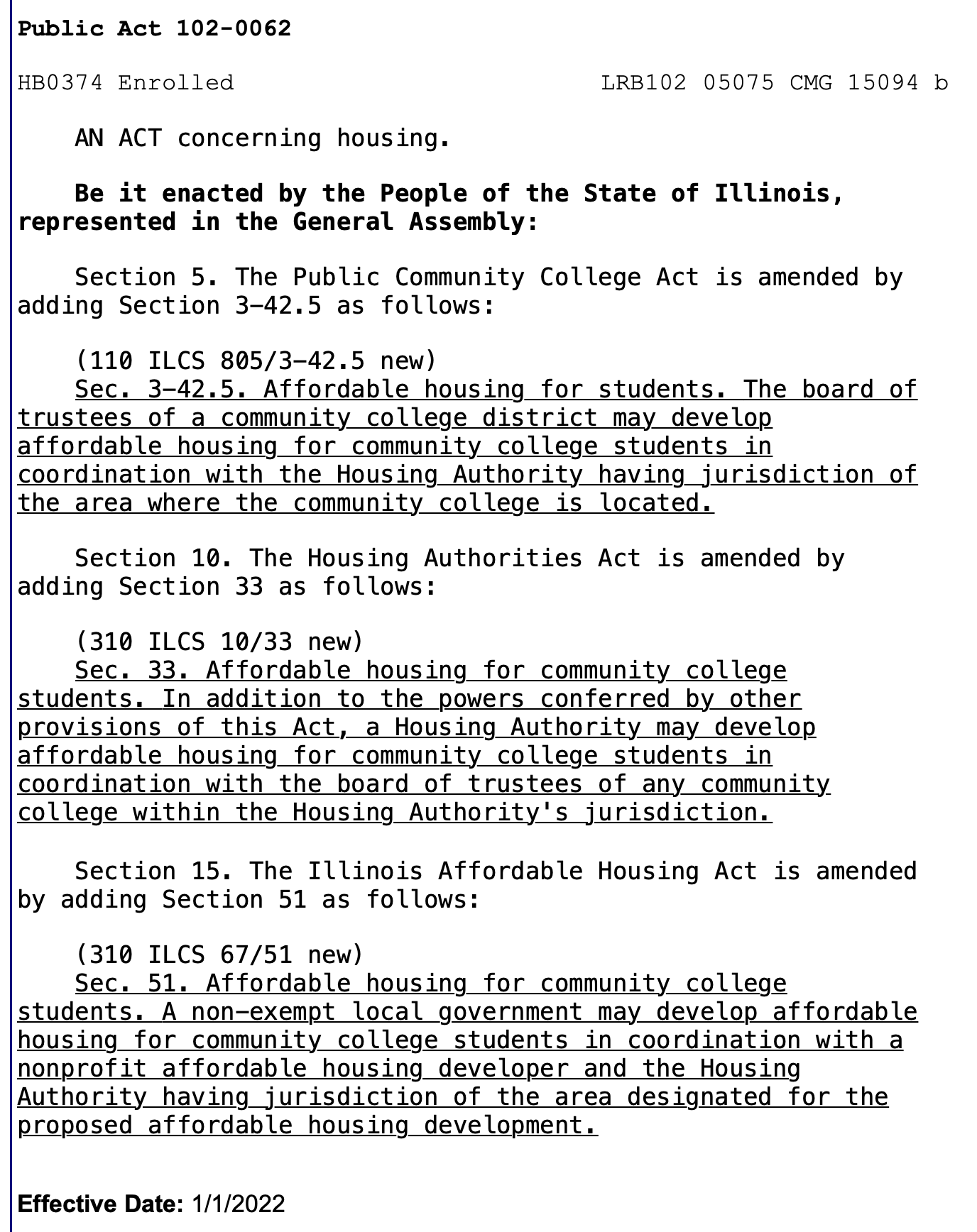
The Illinois General Assembly and Governor Pritzker just gave community college districts in Illinois the authority to work with local housing authorities to develop affordable housing. The bill, HB0374, takes effect January 1, 2022. The text is very short (see the screenshot below or read the bill).

Image

What does this mean for community college districts? It probably means that they can lease their land to the local housing authority for that local housing authority to develop affordable housing for the community college’s students and their families.

The land is essentially free, since it’s already owned by the community college districts and it’s not taxed. Plus, community college districts have their own taxing authority (subject to caps) that can be used to pay for bond-based debt.

Three opportunities in Chicago

I’m going to point out three community college locations in Chicago that could be great places for new and affordable student housing to be built.

Malcolm X College

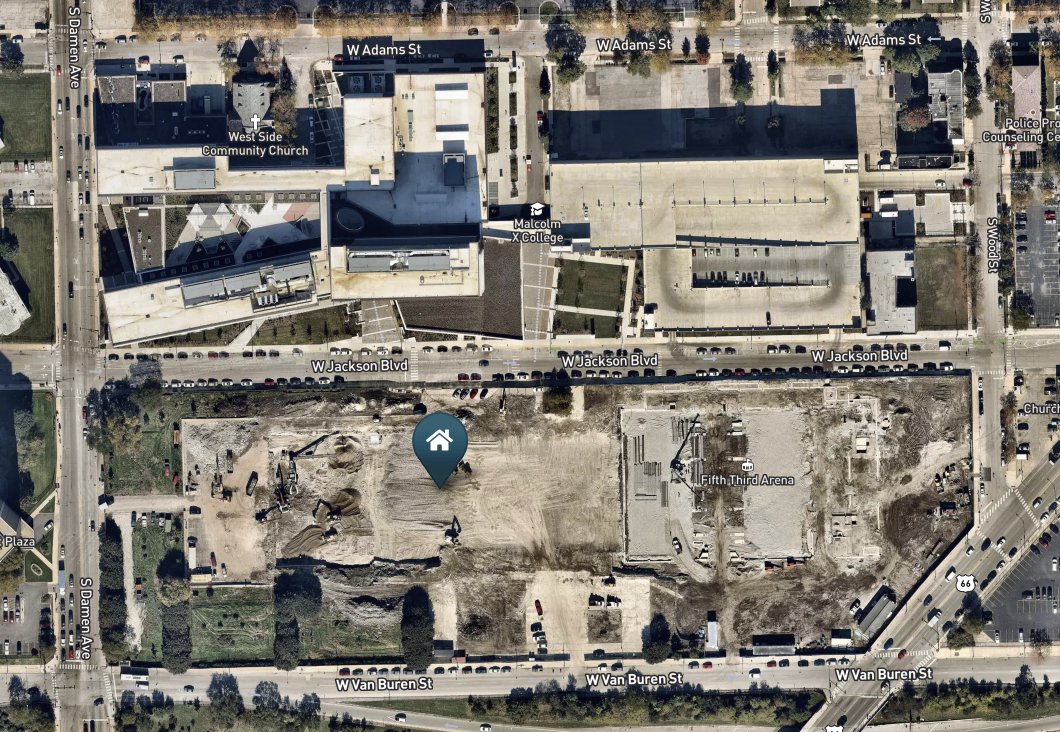
Across from the New Malcolm X college was the original Malcolm X college, and now it’s a huge vacant lot. The Community Colleges of Chicago sold it in 2016 to the City of Chicago, which sold it in 2017 to Rush University Hospital System (which is across the Eisenhower Expressway to the south).

Image
The land across from the New Malcolm X college has been vacant for half a decade.

Welp, Rush also wants to build housing – for unhoused people who use emergency rooms as a way to live and be housed. (People’s health dramatically improves when they have permanent housing and hospitals spend less money on treating them in expensive-to-operate ERs.) Rush and the Chicago Housing Authority could develop housing for both populations – the chronically sick and students – using funds combined with the Chicago community college district.

Additionally, the Jackson bus takes people to and from downtown, and the Blue Line has a station at Illinois Medical District a block away.

Humboldt Park

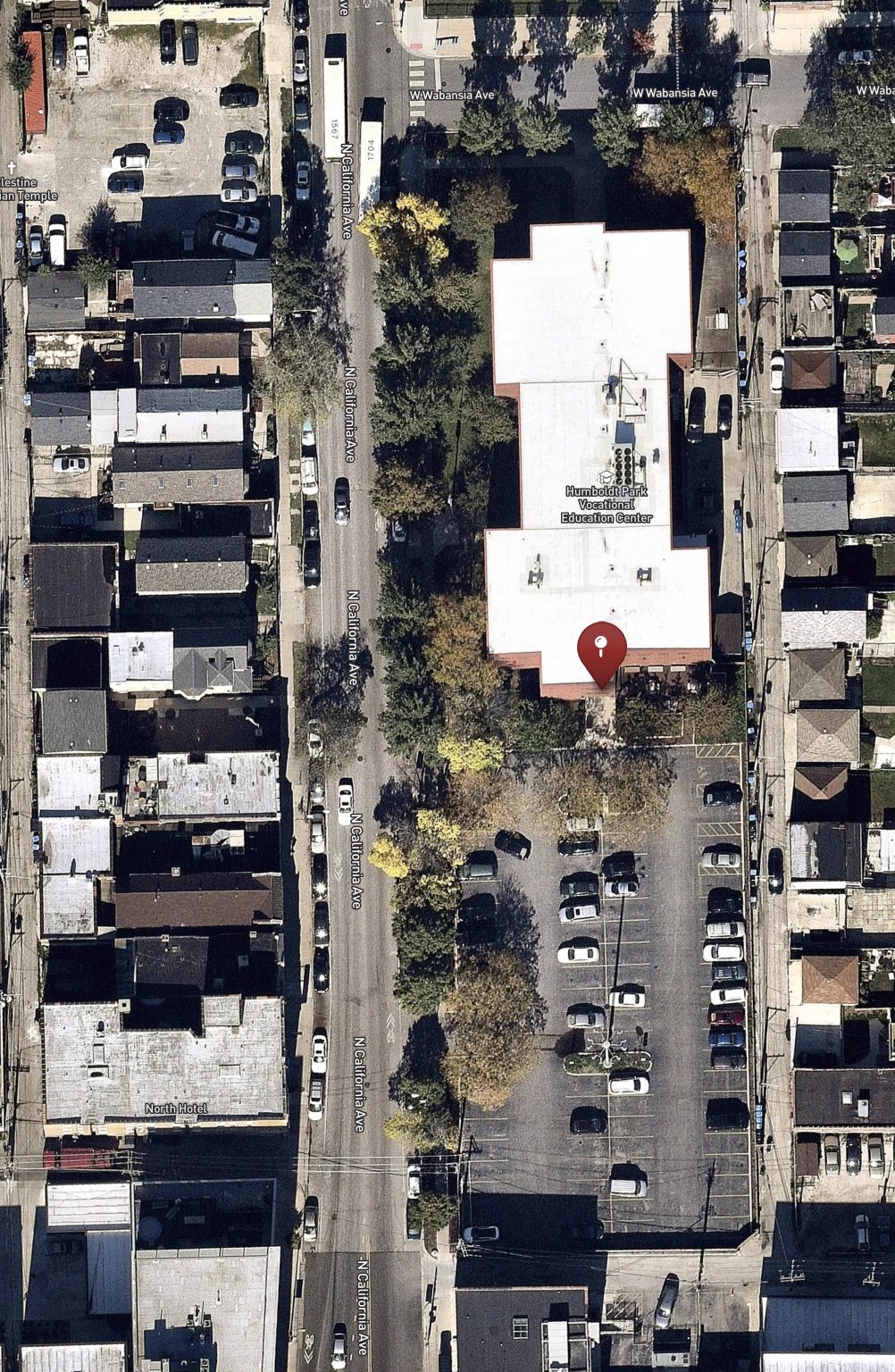
The Humboldt Park Vocational Education Center, which is operated by the Wilbur Wright community college, is another prime location for student housing. The center has a huge parking lot and lies along the California Avenue and North Avenue bus routes.

Image
Humboldt Park Vocational Education Center and its parking lot, which takes up more area than the building.

Parking lots love to be turned into homes, especially in gentrifying areas. That’s free land in a high-demand area where rent is north of $1,200 for a 1-bedroom apartment (I’m using HUD’s Fair Market Rent for the 60647 ZIP code).

Dawson Technical Institute

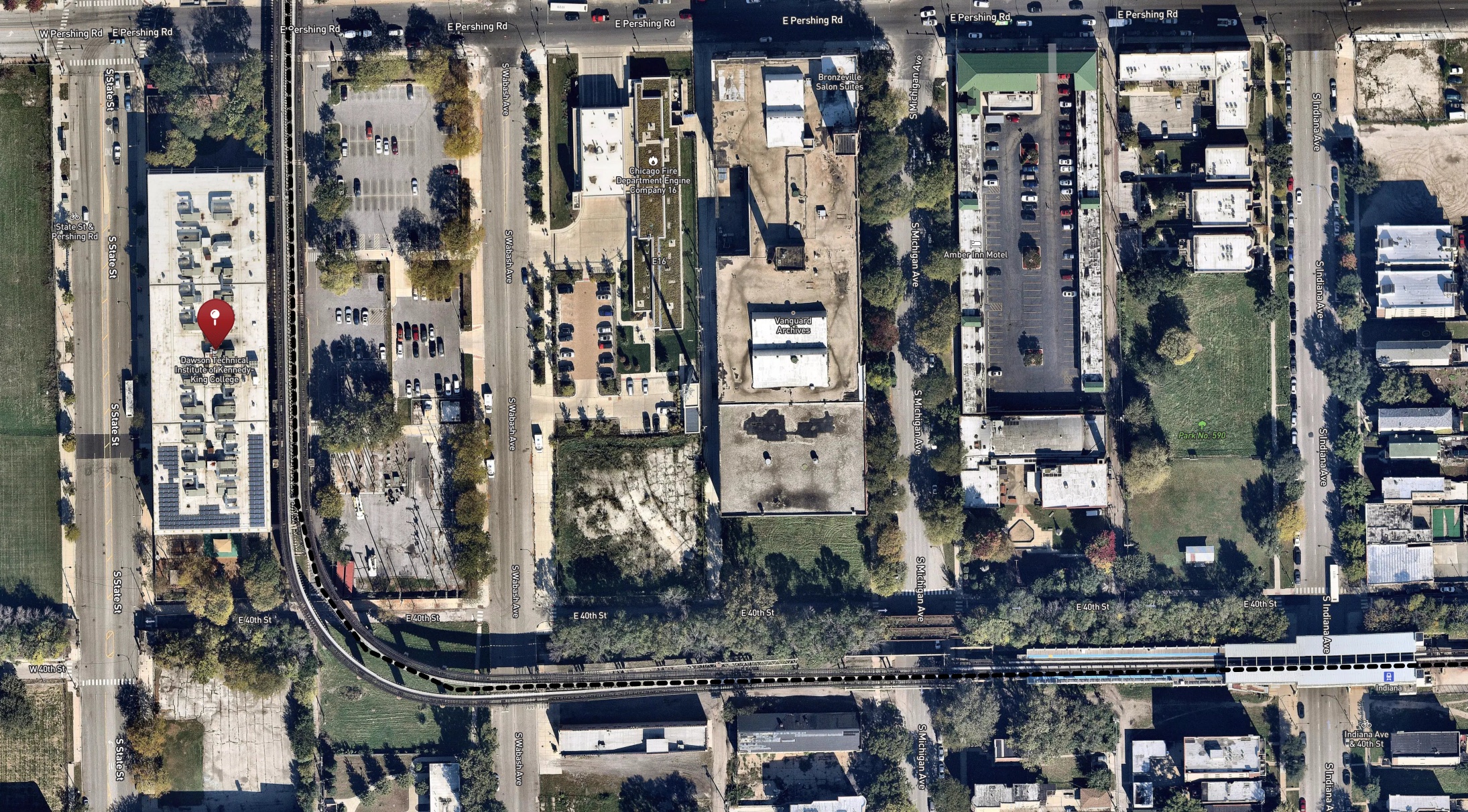
Then there’s Dawson Technical Institute in Bronzeville, which is about 2 blocks from the Indiana Green Line station and several east-west and north-south bus routes.

Image
Dawson also has a massive parking lot, on the opposite side of the Green Line tracks from the building on State Street.

Dawson teaches construction trades, which is perfect because the Green Line can take students to internships and jobs at all of the new construction in Fulton Market that’s ongoing and going to continue for the next three years (at a minimum).

What other good affordable student housing construction opportunities do community colleges in Illinois have?

Biss gives a short speech about good city-building policies

Transcript (I wrote this):

“We need the right land use policies, so around things like parking minimums, which are catastrophic, around things like height rules around transit nodes, around things like the way that bike lanes operate, and the design of roads that kind of allow for 35 mph and not 25 mph…all that stuff that we know is a disincentive to walking and cycling, is embedded in our municipal land use policies.

“What the state should do is not just increase investment in mass transit, but then condition that investment on municipal polices that encourage the kind of mixed-use development, transit-oriented development, walkability, bikeability.

“If you do that, if you have state dollars tied to these policies, you can change municipal polices across the state, and then you can have a real revolution in walkability and bikeability.”

Need help voting? Check out my crowdsourced voting guide for friends!

Vote “no” on the proposed constitutional amendment to create a “transportation lockbox”

Updated Oct. 10 with more examples of why this could be a problem. Updated Oct. 13 to include CMAP’s review of the amendment. I also posted an alternative version on my new Medium account

Illinois voters are being asked in the current election – early voting has started – to support or opposed a constitutional amendment that would restrict spending of certain revenue sources.

The amendment to the Illinois constitution says that revenues derived from transportation sources – gas and related taxes, license and registration fees, sales taxes for transit, airport fees – can only be used to fund transportation initiatives. (see full text below).

The problem this amendment intends to solve is that sometimes Illinois legislators spend transportation funds on non-transportation projects, people, and services, depending on their priorities at the time – even when existing laws says they can’t.

Your ballot says: “The proposed amendment adds a new section to the Revenue Article of the Illinois Constitution. The proposed amendment provides that no moneys derived from taxes, fees, excises, or license taxes, relating to registration, titles, operation, or use of vehicles or public highways, roads, streets, bridges, mass transit, intercity passenger rail, ports, or airports, or motor fuels, including bond proceeds, shall be expended for other than costs of administering laws related to vehicles and transportation, costs for construction, reconstruction, maintenance, repair, and betterment of public highways, roads, streets, bridges, mass transit, intercity passenger rail, ports, airports, or other forms of transportation, and other statutory highway purposes, including the State or local share to match federal aid highway funds.”

A “yes” vote means you want the Illinois Constitution to have this amendment.

A ChiHackNight member asked the #transportation channel in our Slack about this amendment.

Just got my copy of Proposed Amendment to the Illinois Constitution and bicycle and pedestrian paths are perhaps intentionally not listed as possible places to spend transportation tax revenue. Thoughts?

Very little (oh, so little) money is spent on bike and pedestrian things. Despite what you’ve read, there’s no way to guarantee that the recovered money – the small portion that’s being diverted – would be used to enlarge the pot spent on bike, pedestrian, or transit projects.

Existing laws dictate how the money is supposed to be spent

Many of the money categories in the amendment are already protected by either state or federal law. For example, the Passenger Facility Charge that each airline traveler pays to each airport on their itinerary can only be used on certain capital improvement and maintenance projects at that airport. The PFC differs by airport.

And just so we’re clear, there is no such thing as a “road tax” or “driving tax” in any part of Illinois. There is no fee for anyone to use the roads. What gas taxes are supposed to be spent on, first, and then allowed to be spent on, second, are defined in 35 ILCS 505/8 (from Ch. 120, par. 424). 

Bike lanes and sidewalks are rarely called out separately because they are part of streets and roads, which are funded, and I don’t think it’s significant that the constitutional amendment doesn’t list “bicycles” and “pedestrians”.

It’s up to IDOT and other agencies that have jurisdiction over a road to choose to include those things as part of larger road changes. This constitutional amendment won’t change any policies, which are already mildly supportive of bike and pedestrian infrastructure.

Priorities and policy makers are the problem

I oppose this on the grounds that it restricts setting state priorities while it doesn’t actually prioritize anything within transportation.

Sometimes there are things that are more important than what the state buys with transportation money.

I have a huge problem with those things it buys, though. The priorities that Illinois legislators have for spending transportation moneys isn’t going to improve.

The state built the MidAmerica-St. Louis airport in Mascoutah for $313 million to serve as a “secondary” airport to the St. Louis airport. It opened in 2000. There are only flights to tourist destinations in Florida; the St. Louis airport never had a capacity problem.

The Illinois Department of Transportation wants to extend the St. Louis light rail through rural areas for 5.3 miles, but is still obtaining funding. However, they are spending about $300,000 annually on something for this project.

Illinois budget line item screenshot

A screenshot of the Illinois FY17 enacted appropriations showing spending $330,010 annually for a project to extend a light rail station to an underused airport that cost the public $313 million.

That is exactly the kind of thing that has to stop and this amendment doesn’t do it. That money can still be spent on bad projects. There’s no shortage of bad projects, but there’s also no shortage of good projects that don’t get funded. States are already spending most of their money on new roads instead of maintaining existing ones.

Since projects are often selected and prioritized to serve political needs, and politicians oversee specific geographies, good projects will still linger in some geographies while bad projects are implemented in others.

In other words, the $300,000 on spending for the light rail extension to the underused airport can’t go to build pedestrian overpasses along well-used multi-purpose trails in DuPage County. It’s going to stay in that downstate legislator’s district because “economic development”.

Staff at the Chicago Metropolitan Agency for Planning, Chicagoland’s designated regional planning organization, issued a memo to the board a few days before I wrote this describing that the amendment is “unclear” on so many topics. They cite their discussions with unnamed amendment proponents who explain how the lack of clarity won’t be a problem because the General Assembly can pass laws clarifying that bike lanes won’t need a dedicated user fee if the amendment passes and that it doesn’t impinge on the rights of home rule cities to use gas taxes as they need to.

Spending is based on politics, not performance or need

With the amendment, the state will have to dream up some other transportation project in that district – I see a highway widening in their future. Without the amendment, the state could use that money for an important project in that area, but even that isn’t supposed to happen because the state already has laws dictating how project-specific bond funds can be spent.

This is also the problem with the Illiana Tollway that Governor Quinn so much wanted to build to gain favor with Southland legislators.

Whatever the case is, adhering more to performance (merit) measures on transportation spending – rather than political and district appeasement – is the most important change we can make.

It makes us inflexible

Finally, I question the amendment text. It’s hardly possible or easy for us non-legislators to know if the text covers everything that transportation funds are currently allowed to be spent on. What if there’s some project that turns out not to be an eligible recipient for these funds? Do we wait for the next election when we can get another constitutional amendment on the ballot, or hope that the Illinois Supreme Court will interpret the amendment to favor that project?

In fact, we already have a lot of laws that say how transportation-derived moneys are to be spent. The amendment, then, is a solution to the problem of trusting our state legislators.

The Civic Federation says that money is transferred from the various transportation funds to close budget gaps. “Limiting access to transportation-related revenues such as motor fuel taxes and motorist user fees could put additional strain on the State’s general operating resources” and “similarly affect local governments”. They also said that year-to-year figures of transfers and diversions have been calculated differently.

Additionally, DOT workers’ pensions may be paid for by transportation funds. Does this amendment cover that provision? If not, where else in the state’s budget would their pensions be funded?

Some of the work done by staff at other state departments is funded by some transportation user fees. Would the lockbox cut off their funding supply? A little of the work each department can be considered transportation related, but will the road lobby proponents of this amendment see it that way?

I dislike the inflexibility the amendment creates. Constitutions are meant to protect our rights. I don’t think that there’s a right that gas taxes must be used to pay for roads, while a sliver goes to build new CTA stations.

My writing partner at Streetsblog Chicago, John Greenfield, wrote an article that interviewed leaders at three transportation advocacy groups who were all in favor of the proposed amendment. The Tribune editorial he responded to is against it because it seems like a scam that the road lobby is promoting.

I am not in favor of the amendment.